Industry × Data × AI agents · My product · Live · agents pay per call
thecablecode
Decodes, designs and checks cables
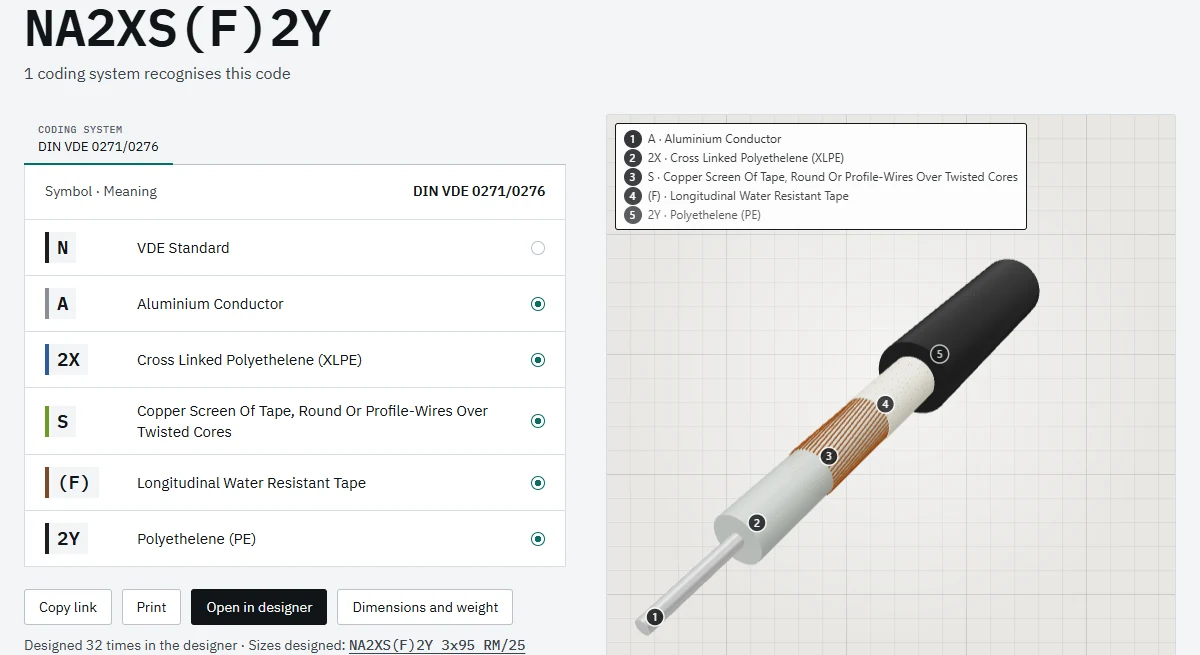
A cable designation is the whole cable in a few letters: the standard, the conductor, the insulation, the screen, the armour and the sheath. Type one from the cable, its drum label or its datasheet, and it is decoded across 68 coding systems and drawn in 3D, layer by layer. Then it goes further: design a power cable to IEC 60502 and download it as a solid, find its equivalents in other national standards, check a datasheet against the rules. AI agents get all of it through an API and an MCP server, and pay per call in USDC. I built the first version in 2016 and rebuilt it in 2026.
- Read any code: type a designation from the cable, its drum label or its datasheet and every layer is explained, numbered and drawn in 3D, across 25 national letter-code standards and 43 type-name tables.
- Design a cable: describe it in a sentence or build it layer by layer, from low voltage up to 500 kV, with each thickness sized by the standard and drawn to scale, then export XML, DXF, SVG, CSV, a GLB model, a STEP solid or a one-page PDF datasheet.
- Compare and check: find a cable's equivalents in the standards of 15 countries, from the Netherlands, Britain and Germany to India, China, Japan and the US, or check a maker's datasheet or tender clause against IEC 60502, HD 603, HD 620 and the BS rule sets. Every verdict comes from deterministic rules.
- Look it up: outer diameter, layer thicknesses and weight with their sources, CPR fire classes such as Cca-s1b,d1,a1 and the tests behind them, and reading guides for each coding system. The whole site reads in 15 languages.
- Licence the engine: the 3D cable engine, one JavaScript file with white-label use, is licensed to cable software firms and makers from $5,500 a year, and a private demo can carry a prospect's own logo and colours.
- Built for agents: a remote MCP server with twenty tools to decode, design, find equivalents, check, read a datasheet, write a specification, fit a drum and run the installation calculations, a REST API that also takes up to 500 codes in one call, an OpenAPI 3.1 contract, JSON schemas and an llms.txt. It is listed in the official MCP registry, so an agent finds it and uses it with no human setup.
- Machines pay machines: after 5 free decodes a day, each costs $0.10 in USDC over x402 on Base, with no account or API key, settled wallet to wallet. Batches cost $0.03 a code, designs and checks $0.50 after two free a day, the datasheet reader $2.00 a document, and a specification $2.00 for the first cable and $0.50 for each further one. The site never holds the money.
- Agents buy sponsorships: an agent can quote, order, pay for and renew a sponsor slot by API, and it goes live when the payment settles. Sponsors never change a decode or its ranking.
- Deterministic by design: the same code always gives the same, explainable answer, which is why an agent can trust it. AI tools help check the data offline; they never decide a decode.
- Rebuilt at parity, then wider: the 2026 rewrite matches the 2016 decoder on all 4,950 recorded test inputs, then adds 43 type-name tables, LAN cables from Cat3 to Cat8.2 and fibre, and Chinese GB and Indian IS cable families.
- On site, before the pull: voltage drop with reverse sizing, NEC conduit and tray fill, pull tension along a route, burial depth by country, laying in cold weather, and drum loading and handling. Each gives a free verdict; Pro adds the worked numbers and a PDF.
- Plans for people: Free, Pro, Team for three seats, a Project pass and Enterprise. A describe-it box that also takes voice, and a project specification written from the designer.
- Accessories for the cable: the glands, cleats, lugs, ferrules and joint and separable connectors that fit a decoded cable, with lug and ferrule sizes from the DIN standards.