Ayhan Güngör · 5 projects

I build where AI meets operations.

Operations software works only if the people doing the work keep using it. MySeaBase is my own app for running a boat: the captain logs the day and the receipts, and the owner approves spend before it happens. The other three were built with clients: an operations dashboard for about 100 buildings in New York that starts by retiring a manual work-order sheet, Interface Map, which keeps an engineering project’s interfaces, owners and open decisions on one approved record, and Lintara, which gives a plant contractor one record from document to progress payment beside the owner’s system.

Ninth Life Lab, my studio, brings the same parts to small and mid-sized companies: software built around how they already work, with agents that ask a person before they act.

Where AI is used, each agent does one job, and decisions stay with people.

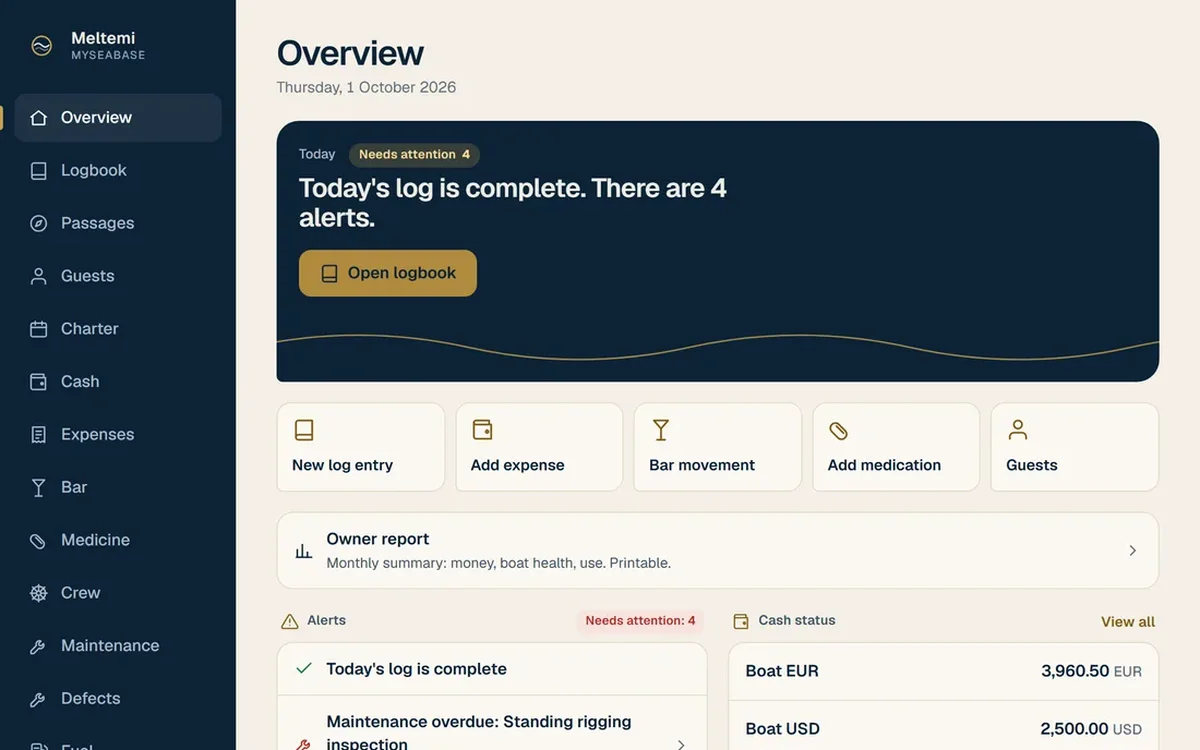
MySeaBase overview on iPad: today's log, alerts for overdue maintenance and safety equipment, and cash per currency

Maritime × SaaS · My product · Live · early access

MySeaBase

One app for the whole boat

One calm app for the whole boat. The captain logs the day, snaps receipts and keeps maintenance on time; the owner approves spend before it happens and gets a monthly report.

  • Multi-boat SaaS: one database per boat, roles for captain, crew and owner, two-step login, and a fleet sign-in for owners with several boats.
  • Works offline at sea: entries queue on the phone and replay exactly once when the signal is back, with the server rejecting duplicates by operation id.
  • 25 features live, from receipts and defects to passage tracks and crew hours of rest. 23 test suites gate every deploy on the server.
  • Eight interface languages, a 30-day free trial anyone can start from the site, safety checklists and drills, charter APA, and read-only API keys, webhooks and Xero / QuickBooks export.
  • Self-service move-in: a spreadsheet import with a check, a report and undo, a setup that knows catamarans, motor yachts and gulets, and a demo boat anyone can open from the site.
Property management × AI · Client build · Phase 1

Property operations platform

Operations dashboard for about 100 buildings

An operations dashboard for about 100 buildings that retires a manual work-order sheet first, then connects the property, accounting and banking systems around it. Six AI agents, each doing one job (intake, learning, duplicates, system sync, morning brief, assistant), while decisions and approvals stay with the team.

  • Accounting, connected read-only: each bill is matched to its building, its work-order row and the bill sent on to the building; about 940 bills synced on the first day.
  • A short morning list grouped by whose task it is, beside the full feed. Money views show bills to pay, possible double payments, approval limits, insurance renewals and gaps in utility bills.
  • Ask about a document: bylaws, an offering plan, a lease or a contract answered with quotes and the page, and up to three files compared, such as two proposals for one job.
  • Same trip: small handyman jobs at one building are gathered into one visit, sent as one plain WhatsApp message.
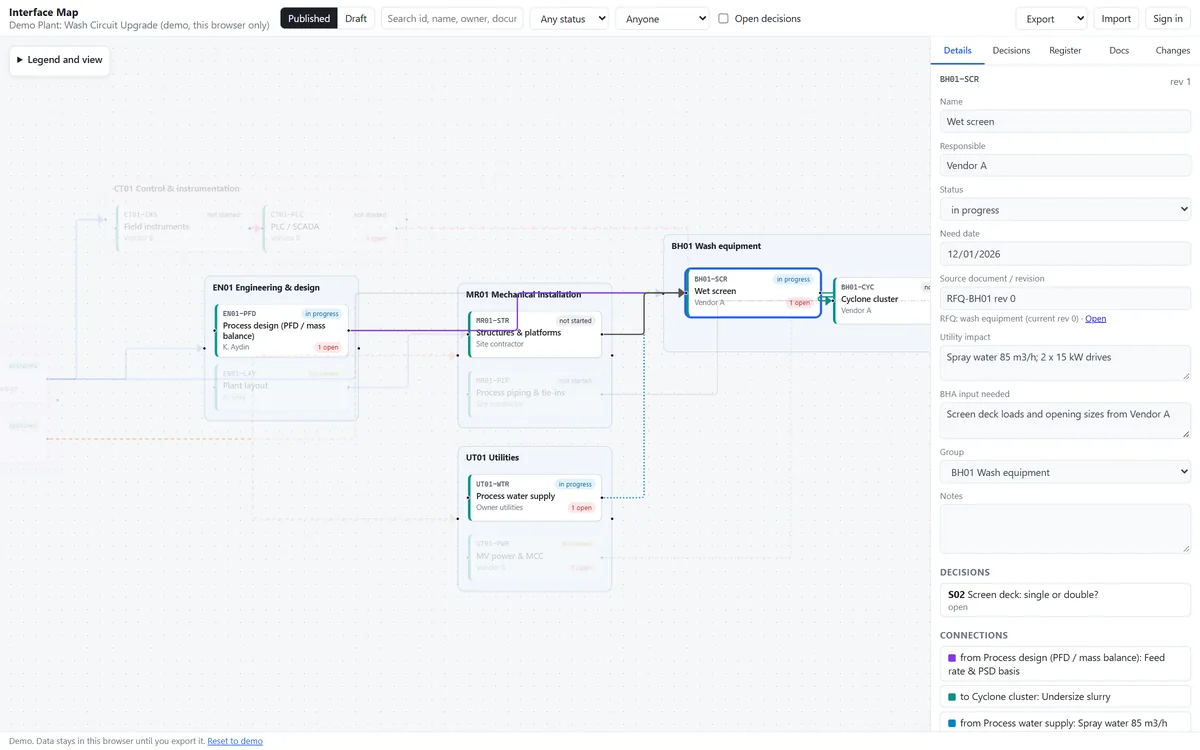
Interface Map demo: a wash circuit upgrade drawn as work packages with owners, status and open decisions, next to the record card of the wet screen

Engineering projects × SaaS · Client build · Pilot · live demo

Interface Map

Interfaces, owners and open decisions on one approved map

Engineering projects keep their interfaces in an Excel register, draw them in Visio and chase decisions by email, and the three drift apart. Interface Map keeps one record of work packages, interfaces, owners, documents and open decisions, draws the map from it, and nothing counts until an approver publishes it.

  • Click any box: owner, source document and revision, open decisions, need date, utility impact and the inputs still owed, with search, filters and a downstream impact view.
  • Draft, then publish: viewer, editor, approver and admin roles; publishing raises the revision of every changed record. Moving a box changes the layout, never a record.
  • A history that cannot be quietly edited: every edit, publish, comment and membership change is chained to the one before it, and the app shows whether the chain checks out.
  • Out to the documents people already use: the interface register as CSV for Excel, the map as PNG or SVG, and Mermaid text for Word.
  • Free building blocks: React Flow and ELK in the browser, a dependency-free Node API with SQLite on my own server, invitation-only accounts and nightly backups. No licence fees.
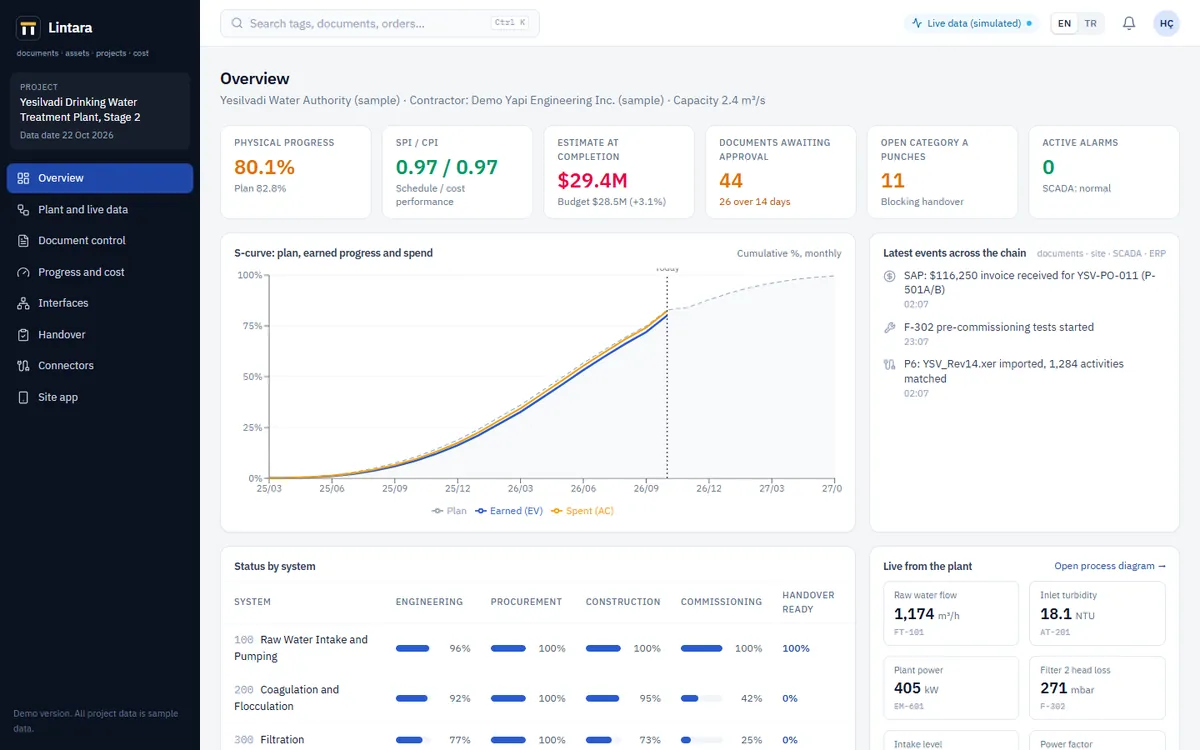
Lintara demo overview: physical progress, SPI and CPI, estimate at completion, documents awaiting approval and an S-curve for a water treatment plant project

Project controls × AI · Client build · Early access · pilot

Lintara

One record from document to progress payment

Document control, progress and cost for industrial projects, on one record. Lintara works beside the owner’s CDE, Aconex or Excel, instead of replacing it: documents and transmittals in, progress computed from the deliverables, and the progress payment drawn from the same record. Early access now, starting with a pilot on one work package.

  • Beside the owner’s system: the contractor keeps its own document register, imported from Excel with English or Turkish headers, and reads the owner’s transmittals from Aconex or Excel, matching each line by document and owner number and flagging revision mismatches and unknown rows.
  • Progress from the deliverables: engineering progress follows document status under credit rules agreed with the planner, by system and discipline, and every change is written with an audit entry.
  • The payment from the same record: the Turkish progress payment set and FIDIC interim payment certificates, in USD and TL, drawn from the progress already on the record.
  • Completions and commissioning: systems and subsystems, check sheets generated for each tag, punch items with waivers, and certificates whose contents freeze when they are signed, in order.
  • Safety records on the same project: plan acknowledgements, toolbox talks, audits and contractor pre-qualification.
  • Next, AI on the record: reading the title blocks of incoming drawings and answering questions with their sources, every answer approved by a person. Built, and switched off until it is tried on the pilot.
  • Live plant data as an add-on: the demo reads a Siemens S7-1500 style server over OPC UA, read-only, and shows the PLC address behind every value on screen.
  • Research first: seven reports across document control, asset data, project controls, OT and the incumbents found no product that keeps documents, tags, activities and cost in one model.
  • Arabic and Russian: server messages, e-mail notices, Excel lists and 77 help articles, with Hijri dates and Arabic-Indic digits in reports and files; a native speaker review comes next.
  • Claims and payment evidence: delay events with responsibility and concurrent delay on the claim page, a photograph album printed with its pictures, and insurance checks that flag days without cover between policies.
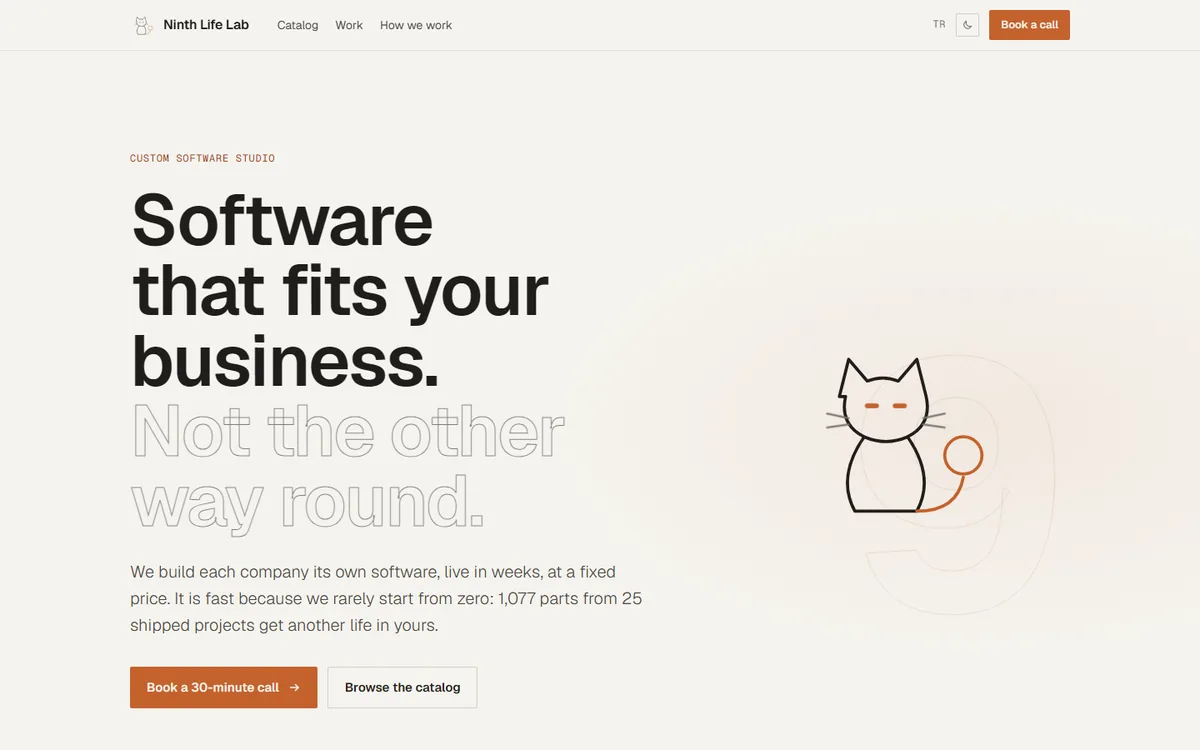
Ninth Life Lab: Software that fits your business. Not the other way round. Next to it, the line-drawn cat with a ball of yarn

SME software × AI agents · My product · Live · new studio

Ninth Life Lab

Custom software from parts that already work

My curiosity lab turned into a studio. Ninth Life Lab builds small and mid-sized companies their own software, live in weeks at a fixed price, from 1,613 parts that already run in 27 shipped projects. The catalog lists 74 products, each one running somewhere today; a company picks what it needs and books a call.

  • A catalog, not a pitch: 74 products on 15 shelves, from the inbox to stock, quotes and reports, each made of parts that run in a live project. A basket turns a selection into a request.
  • One shared core for every client: agents run on a common runtime with an approval queue for anything that costs money or reaches a customer, a monthly AI budget and a log of every action.
  • First agent, stock replenishment: it reads sales from the shop's own spreadsheet, proposes purchase orders and writes them only after the owner approves.
  • Fixed price, then we run it: a price per deliverable before the work starts, then hosting, watching and adjusting for a monthly fee.

Want something like this for your team or product?